Sunday, April 20, 2025

Remembering Petter Naess

If you've heard the Ministry of Culture play in Oslo over the past few years, you've quite likely heard Petter Naess's voice, guitar, and jaw harp.

First of all, apparently Petter Naess is a fairly common Norwegian name, so the one you know might still be alive.  But the one I knew was evidently born in 1951, and died on March 29th, 2025.

Petter was quite a preeminent scholar of urban planning, from what I gather.  This certainly seemed evident in conversation, not that he ever bragged about his achievements, but it was clear that he was deeply knowledgeable in his field.

As one might expect of a Norwegian professor of urban planning, Petter lived in a beautiful housing cooperative and rode a bicycle everywhere.  As with his fellow Norwegians, he never let the weather get in the way, since he had the right clothing to stay dry while bicycling through whatever the sky had to offer.

I became familiar with such details of Petter's life over recent years because every time I was planning to come back to Norway, Petter was intent on organizing another concert for me and his band in Oslo, most recently a few months ago at Cafe Mir.

When I first met Petter he was teaching in Aalborg, Denmark.  Every year I was coming to Aalborg to play at the punk rock social center, 1000Fryd, and every year there would be a tall, thin, dark-haired Norwegian man among the mostly Danish audience.

He got a job teaching in Oslo and eventually I'd see him at shows there instead, and eventually he became that tall, thin, white-haired Norwegian professor instead.

It was around four years ago, as memory and my record of emails we've exchanged seems to indicate, which coincided with his semi-retirement from the university, that Petter got into playing music and writing songs again.

He contacted old friends that he had formed a band with in 1975, called Folk Flest.  Norway is long, and the other band members lived in parts of the country nowhere near the capital, but they started up a new tradition of doing annual shows in Oslo with me and Kamala anyway.

Petter was one of the most athletic guys in their seventies that I knew, and I'm sure I'm not the only one who is shocked he died so young.  I was truly expecting to be seeing him around for at least another twenty years.  I gather he died while literally running through the forest as part of an orienteering event, which sounds a bit like a fast-paced Easter Egg hunt for adults, as far as I can tell.

Petter lived in an eastern neighborhood of Oslo that was once downwind from industry, as the east sides of so many cities generally used to be.  It's a high-altitude neighborhood with a big vista of the city, just on the edge of a forest.  From Petter's home, the forest is very close.  He knew it well, and took Kamala and I hiking in it on one memorable occasion.

The second-to-last show Petter organized for us at Cafe Mir was especially memorable because the night of the gig happened to coincide with the day Stella Assange was receiving an award on behalf of her then-still-imprisoned husband, and Stella and crew came to the show, where filmmaker Niels Ladefoged managed to make a viral video of Julian phoning Stella while Kamala and I were singing a song about them.

I believe many of the songs Folk Flest were doing at our shows together in recent years were songs they had first written in the 1970's.  Here's one from the last show we did together in Oslo, a song just as relevant as it ever was, unfortunately, on a subject that very few artists in much of the west dare to speak out on -- "Free Palestine."


Tuesday, October 1, 2024

2048: a novel

If I vanish from view for a long time, it'll probably be because I'm writing a book.

I've got a novel germinating in my brain lately.  As time goes by, thinking about it takes up increasing amounts of space in my head.  Which, when it comes to big projects, is usually an indication that it will be happening, one way or another.

Most of the writing I've done has been in the form of songs and essays.  Both are wonderful for what they are -- to share some recent news, to introduce people to a subject, or as a community-building exercise.

But as I think about trying to explain what a contemporary or near-future revolutionary social movement could look like, of the sort that might succeed in mobilizing forces in a society like the US to transform it and its politics and create something beautiful in its place, I find myself gravitating towards trying to tell this hypothetical story in the form of a novel.

I guess it's obvious why this calls for a long-form type of storytelling.  The idea is to tell the story of the process through which the world got to the dismal state of affairs that will be the 2030's, in my imaginings, and how, in the 2040's, it begins to dig its way out. 

I want to tell this story from many different angles -- centering in the tale the social movement participants and leaders, and many other elements integral to developments, such as press, politicians, intelligence agencies, and all sorts of other people from the many different countries that will be essential to the telling of this tale.

I've done enough writing to know how daunting this task is -- how time-consuming, and all-consuming such a project can be.  I find the idea of embarking on it enthralling, but also overwhelming.

One of the factors that tend to diminish my enthusiasm about spending inordinate amounts of time researching and writing and rewriting for a project like this is the prospect that it will never get published after it's done.  Another is even if it ever does get published, it still may not be widely read, and I may wonder why I isolated myself so long to work on it.

Other worries that may seem strange include the fear that I'll stop doing all other kinds of writing, once I embark on this project.  That's what happened when I started writing children's songs back in 2007 or so.  I didn't write anything else for about two years.  I could only think in terms of children's songs.

Of course, if I just keep going with writing more songs about Israel's genocidal bombing campaigns, or I write a novel, it probably doesn't change the world either way.  Or if it does, I wouldn't know which pursuit might be more or less worthwhile.

I feel like I'm circling around the edge of a volcano before I go jump in and see if it's hot in there.  Or perhaps it's more like standing on the edge of a lake before jumping in.  That sounds more reasonable.  Or tying up loose ends with relations before going off to work at the space station for an open-ended, long assignment.  Or perhaps the mines.

In any case, I guess this is just to let you know that if I disappear for a long time and you barely hear from me, it's because I'm writing.  Along the way I'll likely be looking for all kinds of help -- people to ask about cultural or technological questions, people to read and give me feedback, people involved with publishing, writer's retreats, and who knows what else.  Advice welcome!

Thursday, September 19, 2024

The Anxiety

Some thoughts on anxiety, its sources and solutions.

I've been consuming global news from various sources on a daily basis since I was twelve.

Nothing quite like these exploding pagers and other devices has ever come up as a news story.  The horrors of the indiscriminate use of cluster bombs, land mines, white phosphorous, yes -- and there are many similarities in terms of the injuries.  The completely random, everywhere-at-once nature of these terrible events is different though.

Ever since Israel's Stuxnet virus attack on the Iranian nuclear industry, I've been anticipating something like this, as have others.  What's been happening in Lebanon over the past few days is a slight variation from a plot line I still intend to write about, part of a big-picture, near-future kind of novel, partially inspired by the recent hit, Ministry for the Future.  The fact that reality is playing out much like my fictionalized version of it had things going makes me want to write that novel even more.

Perhaps it won't just be the Lebanese, Palestinians, Syrians, or Iranians who can look forward to a future of never knowing whether your phone is going to blow up in your face, or you're going to be assassinated by a small drone which announced its presence with about as much fanfare as a large mosquito.

It's certainly not just them that can wonder whether their town is going to be swept away in a giant flood, or burned up in a fire.  Certainly not just them that can wonder when World War 3 between Russia and NATO may be coming to wipe out life as we knew it, or when the climate catastrophe is past its tipping point, and we're unstoppably on our way towards Venus.

When I visited Lebanon way back in 2005, one of the many things that made an impression on me was how most of the people I got to know there were on anti-anxiety medication, and talked about it.

Israel's horrific bombing campaign of 2006 had not yet happened, but Prime Minister Rafic Hariri had recently been assassinated in a massive bombing, and a lot of the more middle class elements of Beirut society who had in recent years started returning, after the end of the civil war, were now leaving again.  The rest were on anti-anxiety medication.

Another thing that made an impression on me in Lebanon and in Palestine -- in Nablus and Jenin, specifically -- was the sense of calm and clarity emanating from the men with guns, of whichever faction.

I wouldn't want in any way to minimize the PTSD and associated ills you can find within the ranks of soldiers worldwide, including soldiers of guerrilla armies.  But it's also easy to observe among the ranks of those who have committed their lives to a struggle like that that participants can find a sort of solace in their commitment, and there is a certain relief to be found in giving up your life like that.  All of them are expecting to die violent deaths.

I don't know if reliable statistics exist, but my impression is there are a lot of people in the US on anti-anxiety medications of all sorts as well, but maybe more in Beirut.

I was listening to a program yesterday, I think it was on NPR, though it could have been BBC or Al-Jazeera.  (As different as they can be from each other in various ways, they all tend to blend together in my head after the fact.) 

When they got to the part where the psychologist was being interviewed about what people, maybe particularly young people, might do about anxiety, depression, suicidal thoughts, etc., related to the climate crisis, I almost turned it off.  I expected some kind of nonsense about how we all need to help each other look at the bright side, while recycling our garbage more enthusiastically.

Instead, the expert, whose name now escapes me, talked about how the efforts of people to "look at the bright side" just tend to make things worse.  It's a lot like telling someone who is facing off with a growling bear to calm down because probably the bear will end up walking the other way eventually.  The climate crisis is as real as the bear, and looking at the bright side isn't going to make it go away, or calm anxieties.

The expert explained further that what does tend to demonstrably alleviate anxiety and other such ills for people concerned with the climate crisis, and the future of life on Earth and such, is solidarity and mutual understanding.  The ones who are part of a community that is trying to change things in one way or another are the ones best able to cope with the anxiety.

I'm paraphrasing, but her conclusions were something like that, and I think they were based on broader studies, not just her own clients.  It was one of those many moments when I hear about a scientific study and feel a bit smug, because of the way they so often tend to prove things that people involved with activism or the arts have known for a long time.

I long ago began to notice that it was so often the case that people I knew who were involved with healing themselves from past trauma by doing lots of therapy, reading books about self-improvement, trying to live low-stress lives, etc., often just got worse and worse over time, the more they "did the work."  If anyone has ever wanted to know my recommendation for overcoming trauma, anxiety (existential or otherwise), depression, and other related ills, I have long said that joining a group or network or community involved with solidarity and building a social movement may actually do you far more emotional good than withdrawing from all that and "working on yourself."

There was another scientific study that demonstrated that people process words very differently, depending on whether they are spoken or sung.  Words, when sung, go right to the emotional centers of the brain.  All the musicians intuitively knew that already.

There is also lots of evidence to support the notion that communities of people that make music together tend to be much closer and happier than those that don't.

For me, personally, it all very much falls into place, when I hear about these studies, because of my ongoing life experience.  I could be a good case study, probably, with regards to the impact of climate anxiety, and other anxieties, and how they vary depending on circumstances.

It's been many years since I've felt like I was plugged in to some kind of active social movement in my home country, the US.  There were many years when I was continually immersed in one or several concurrent social movements in the US, but that was a long time ago now.

In recent years, I spend eight months out of the year in the US, mostly at home, doing very few gigs, experiencing pretty much constant anxiety about the state of the world and the state of the left, coping with the anxiety by various means, none of them particularly effective.

The other four months of the year I'm on tour, mainly in other countries, where there are still social movements that I'm plugged into, that I can participate in musically and otherwise while I'm in the various places I regularly return to.

While I'm on these tours, the state of near-constant anxiety is replaced by a state that is nearly ecstatic by comparison.  The feelings of mutual understanding and solidarity can be overwhelming, in all the best ways, when you're surrounded by a large group of other people who have the same concerns, the same desires, and who are together, literally singing the same song.  

Speaking on a purely emotional level, having an experience like that on a daily basis induces a near-constant state of bliss.  Even every other day will do the trick, and this despite the fact that I miss my small children terribly whenever we're apart for more than a few hours.

I imagine most of the people the climate anxiety psychologist has studied either have an isolated, depressed life full of anxiety, or they've found some kind of community of resistance to be part of.  I'm guessing folks like me, who jaggedly go back and forth from one reality to the other, are less common.

In any case, there's no question either in the studies or in my own experience that when it comes to existential anxiety, being part of a vibrant community of resistance is extremely therapeutic, and the absence of one is extremely anxiety-producing.

I'm not sure how I'd feel if I were Palestinian or Lebanese, though. In those cases I'd likely just prefer whichever option is the least fatal.

Sunday, August 25, 2024

I Survived Chicago

 The Ministry of Culture had very little to do in Chicago, but we were there.

As Kamala Emanuel (the Other Kamala) and I were touring on the west coast, people frequently wished us luck in Chicago, particularly with regards to the Chicago police, who will, for good reason, forever be associated with the police riots at the Democratic National Convention in 1968.

I wasn't worried about the cops.  I've been to Chicago lots of times, and played at lots of protests in Chicago over the decades.  What I was worried about was the protests themselves, and just how much they would suck.  Unfortunately, my expectations that they would indeed suck were borne out 1,000%.

If you are by now bristling with the sentiment that "if you don't have anything good to say, don't say anything," stop reading now!  But if you want my reportback on what a captured, defeated social movement looks like, and my ruminations on how to instead build one that has a chance of actually growing, read on.

When I survey the history of social movements in the US in my lifetime, there are patterns that are fairly easy to observe, that are very strongly supported by the vast amounts of information gleaned from the raid on the FBI offices in Pennsylvania way back when, that revealed in great detail the way the FBI coordinates with local authorities to systematically undermine social movements.

It's easy enough to read about the ways they have historically sought to undermine social movements -- promoting ultraleft tactics, suppressing the careers of prominent figures of all kinds so they don't become too influential, embracing views that may appear righteous but which are actually intended to alienate the public.

What has been easy to observe directly and through various FOIA requests and leaks along the way is that these sorts of efforts have continued unabated since the FBI's Counter-Intelligence Program was first exposed and supposedly ended.  The red squads are alive and well.  We only get the occasional, but clear, hint that the program continues.  

The big picture is one that always has to just be pieced together approximately, until decades later, as a general rule.  But at the risk of once again being called a "conspiracist," whatever that is, I'll tell you what I've been observing since I've been actively involved with social movements in the US and other countries.  Actually I'll start with what my boomer friends observed before my time, since it is just an extension of the same pattern that I've observed throughout my adult life.

The Movement, as it was known to participants, in the 1960's, had become a serious social force to be reckoned with.  There were millions of people who considered themselves to be members of Students for a Democratic Society, whether or not they technically had joined a local club or not.  They had chapters on every campus, and could shut down campuses across the country if they wanted to, which they and the broader student movement regularly did.

The interracial cultural renaissance with its centers in places like San Francisco, Detroit, and New York City had swept the nation and the world with the new sounds of a rebel movement that existed in stark opposition to militarism, racism, and capitalism.  In large part as a result of this deeply musical and inclusive movement's pervasive spread into every corner of the country, the US would not involve its military in a major war for decades, with what they called "Vietnam Syndrome" having infected the hearts and minds of much of the country -- not only because of the horrors of the actual war itself, not only because of the heroic and massive resistance of the Vietnamese people to the imperial invaders, but because of this domestic social movement as well.

The divide-and-rulers did many things to undermine the movement then -- all the usual things that should by now be familiar to you, dear reader, if you live in the US and you've been around a few years, especially.  They promoted ultraleft tactics that would be designed to alienate most people at a given time and place, which would be engaged in, as usual, by a combination of undercover agents and enthusiastic revolutionaries.  They did their best to sow ideological as well as interpersonal divisions within the movement.  

But in addition to trying to divide the grassroots groups that made up the movement, they took their efforts a step further by creating new organizations, that generally seemed to come out of thin air.

At most every point when there has been a movement that involved genuine coalitions of grassroots organizations doing things like organizing massive rallies and other events, there has arisen some form of ideologically rigid caricature of a grassroots coalition that seems to exist entirely in order to undermine the efforts of the actual grassroots coalition.

In the late 1960's this was the process through which SDS was destroyed by the cultish uber-militant group calling itself the Progressive Labor Party, which essentially rejected all the things that had built the movement into what it was, in the name of working class militancy, naturally destroying it, as they clearly intended to do from the outset.

Since first reading Kirkpatrick Sale's extensive history of SDS a long time ago, I believe I have seen this pattern resurrect itself as clear as day on multiple occasions.  Whether I'm right in my suspicions may or may not ever be known, but the pattern I have observed is one that must at least be described, because whoever is responsible for the state we have now arrived at, we will never dig ourselves out of this hole until we start to be able to identify the nature of the hole we are in.

I don't need to consult any elders or read any books to tell you what I've directly observed as an active participant in protests across the US from the 1980's to the present.

I remember the date of the big protest against the gathering war against the government of Iraq -- January 26th, 1991.  The ad hoc antiwar coalition that had come together announced their national protest planned for DC and San Francisco.  No sooner had they done this than another group made up mostly of groups no one seemed to have heard about organized a national protest to take place in the same locations, but a week earlier.

Once the antiwar coalition disintegrated, after the withdrawal of most of the US military at that time from the region, the other antiwar group also disappeared.  Years later, after 9/11 and the invasion of Afghanistan, the same sorts of grassroots organizations once again came together to form an ad hoc national antiwar coalition, called United for Peace and Justice.  

Once again, another group made up of organizations no one had ever heard of came into existence, and started planning protests to happen a week before the ones UFPJ announced.  Once again, this other coalition seemed to come out of nowhere, and though it was full of people no one had ever heard of, it had massive resources, always got permits for their protests, and always got lots of media coverage.  Once again, their protests were full of clearly sectarian, black-and-white thinking people shouting into microphones, with virtually no live music.

The contrast between the grassroots coalition made of up groups people had heard of -- with speakers and performers who generally consisted of the sorts of activists, authors, professors, leftwing politicians, whistleblowers, actors, musicians, etc., that at least some element of the folks going to the protests were familiar with -- as opposed to the coalition that only had sectarian people ranting at the crowd and nothing else, would be impossible to overstate.

In one case you have an inclusive variety of left speakers and artists trying to build a movement, and in the other you have unknown people shouting at you, with no art or music involved in the shouting, either.  In one case an effort at movement-building, in the other, a clear case of an effort at movement-destroying.

With the genocidal war on Gaza since last October, this traditional phenomenon can once again be observed, sort of.  Now, however, there is no competition between a coalition oriented towards building a movement and one oriented towards destroying it.  We only have the destroyers running the show, to the very slight extent that there is even a show to be running, in the US, as opposed to other countries, where the protests are usually far bigger and far more frequent.

I point out this stark reality not to discount the efforts of so many good people who want to raise their voices against the genocide, to somehow put a stop to it.  I'm among this group that desperately wants to see the genocide stop!  Which is why I'm so horrified by the movement-destroying nonsense that I witnessed in Chicago, which I suppose we call protests. 

Unrelated to the horrible programming choices or the rallies, or the decision by some ultraleft elements to try to "shut down the DNC" with a handful of teenagers against 2,500 cops, the city of Chicago was making it impossible for anyone to have a permit to hold a protest or a march anywhere near the United Center, the venue where the main DNC events were taking place.  

Permits were not granted until days before the protests.  It would be impossible to overstate what a devastating impact this kind of anti-democratic orientation displayed by the Chicago authorities probably had on attendance at the protests, when so much was totally up in the air until the very last minute.

But what the people who did show up ultimately had to experience was the sort of debacle that had nothing to do with the holdup in getting a permit or anything else.  Chicago is full of brilliant organizers and artists who could have provided some fantastic content for all the media who were there filming everything.  We could have had medical practitioners just back from Gaza, talking about the horrors they witnessed in the hospitals.  We could have had Medea Benjamin fresh from disrupting DNC events to talk about her recent months spent harassing Congresspeople and beseeching them to stop the genocide.  We could have had musicians performing on the stage whose very moving music about the genocide has been featured on Al-Jazeera.  We could have had this program in place just drawing on local Chicago people, to say nothing of the many people in from out of town.

Instead, what the world's media and a few thousand people who had come from around Chicago and around the world were treated to was a string of speakers most people there had never heard of, shouting at them.  Sometimes shouting about their outrage against the genocide and the American politicians facilitating it, and sometimes shouting at the crowd about how they need to stop just going to protests, and do more to stop the genocide, on the assumption that all they do is go to protests now and then.  The kind of nonsense I heard from the stage at those rallies could only be rivalled by an ANSWER rally, because, as far as I can tell, it's exactly the same sorts of people speaking.

How did this ultra-sectarian element, these obviously black-and-white thinkers who have a clear revulsion for any kind of communication that might be actually effective, who have no interest in art or music or other actually effective means of communication, get to determine the programming for all the rallies in Chicago?

It's a fascinating process, that we can also observe as I mentioned in 1991, 2002, etc.  A group can claim to be a coalition, and get lots of different groups to help get the word out and mobilize people to go to the protests, but in the end somehow or other all of the speakers seem to be from the same extremely sectarian faction that believes in shouting at the people in attendance and engaging in interminable bouts of very boring chants in between each rant.

How this all happens is not entirely clear to me, but that it does, is beyond any doubt at all.  It's easily observable to all, much to the collective horror of anyone who understands anything about what kinds of efforts tend to build a movement, and what kinds of efforts tend to destroy one.

As people know who read my blog regularly, since last October, every time I leave the US, up until last month, I play at protests everywhere, often several times a week, against the war in Gaza.  That organizers of a protest should say "yes" to having me sing at the protest when I'm in town is a no-brainer.  Everyone outside of the US knows that music moves people in so many ways that can be so positive.  Everyone knows how it fosters a sense of community, gives people hope and a sense of purpose.  Everyone knows this, everywhere but in the US.

The biggest of the protests, which had around 3,000 people at it, by my estimation, involved a very nice sound system, though no one might have known how good the sound system was, except if they were there when the thing was being set up, and they were playing music through it.  Once the rally began, the sound system would only be used as a sort of giant bullhorn.

The oft-stated excuse for not including music in the program is that there are too many sponsoring organizations, and everyone wants to speak.  This argument is preposterous in the first place, when you have 200 organizations signed on, and you're obviously not going to have 200 speakers.  It's even more preposterous when you see that the rally started 38 minutes late.

38 minutes during which musicians could have been performing songs about the horrors going on Gaza, filmed by the world's media.  38 minutes when we could have been winning over the hearts and minds of passersby, and drawing them into the park.  38 minutes when we could have been keeping all those children entertained, instead of having them stand around, literally crying from boredom.  38 minutes of dead air.

Then the interminable chanting began.  Eventually, after it seemed impossible that anyone could rasp "free, free Palestine" yet another time, the speakers began shouting at us.

Normally, as a rally continues, it draws in more people, who are interested in the stories being shared, and excited by the music the performers are sharing.  With all of these rallies in Chicago, as new people were arriving, because they were getting in late, others who had already been there since the beginning were leaving.  Not just a few people, either, but most anyone with children.  These were not child-friendly events -- children can get lots out of a good rally with moving speakers and musicians, but they don't like being shouted at.  They like it even less than adults do.

Eventually, the rally became a march, with many of the young participants wearing masks and referring to each other by code names, I guess in order to more thoroughly alienate themselves from each other and from anyone not involved with the march who might be wondering what's going on.

A breakaway group of masked youth from the march headed over to the fenced-off area surrounding the United Center, and pulled some of the fencing down, before being detained and arrested.

This kind of effort used to be the sort of thing that would be organized well in advance, and might involve thousands of people, in which case it might be successful.  Or on many other occasions it might involve thousands of people surrounding the fenced-off area in order to try to shut down the farcical proceedings.  But a few dozen people pulling at a fence and getting arrested?  It's a symbolic act that serves no purpose, aside from making protesters look disorganized, ineffective, and hyper-militant.

It's also a type of action that seems to have become increasingly common over the past 15 years or so in the US -- much more common than well-organized, well-planned acts of civil disobedience, and certainly much more common than efforts at reaching out to the broader world.

You could say there's been a competition for a long time now, between authentic people trying to do authentic organizing, and these groups that appear fabricated, synthetic, made up of strange people who shout all the time when they get on stages, who appear to be a caricature of a left group, as if invented by a low-budget TV studio.  When these two groupings on the broader left were represented by groups as different as UFPJ and ANSWER, it was abundantly obvious to anyone who went to actions organized by both coalitions that UFPJ was trying to organize a movement, and ANSWER was trying to kill it.

Now, however much I might hope for it, there is no equivalent to UFPJ anymore.  There is no group like that organizing protests to oppose this genocide.  We are left only with the rabid sectarians who only know how to organize shouting matches.  The sectarians have won, the left as some of us once knew it is gone, or certainly not in evidence in the past week in Chicago.

As to the circus that was was taking place within the confines of the United Center, I'll leave that for another commentary.  What was going on outside of it was a circus of a different kind.

Tuesday, August 6, 2024

Tim Walz

In the spring of 2022 I found myself for a week or so to be a member of staff for a man who was running in the Democratic primaries in Minnesota, hoping to be the next Congressional representative in Minnesota's 1st District.

The 1st Congressional District of Minnesota is largely rural, with towns like Red Wing being the main population centers. Red Wing is mainly known for its prison, and its shoe company. It's a lovely, though somewhat run-down and post-industrial, little town.

During the week I was there there were these gatherings all over the district that all the folks running for the Congressional seat attended, along with local Democratic Party elected officials and volunteers.

Governor Walz was running for office again along with other state-level Democrats, and they were busily traveling from one of these party gatherings to the next, not just in the 1st district, but in all the rest of them as well.

He and his entourage arrived at several of the events my candidate and I attended. Each time, they interrupted whatever was going on to give their pitch for the Democratic slate, and when they were done, they sped away to their next destination. In one case, my candidate was in the middle of his allotted three minutes to speak to the assembled group in a high school auditorium in some little town, when Governor Walz and his group entered the room.

One of the local Democrats, or perhaps a member of the Walz team, came onto the stage and asked my candidate to stop speaking and let the governor's team do their thing, rather than waiting until his three minutes were up first. They let him resume giving his three-minute speech after the governor and his crew were gone.

Walz seemed to have the same pitch wherever he went, or if he were modifying it for more rural areas like the one he was in, I couldn't tell. Mostly he talked about how intolerant the Republicans were, and how he and the Democrats, on the other hand, supported the rights of teenagers to choose their own gender.

Walz owned the stage, moving around and engaging with the audience, like someone who had given more than a few speeches in his life. People seemed impressed to have such a local celebrity in their midst. The content of his speech, however, didn't appear to me to be connecting with anyone in the room.

I don't know anything else about the guy, but he certainly struck me as a Democrat who embraced whatever the Democratic Party talking points for that election cycle were supposed to be, and he seemed to be functioning on autopilot. None of which is shocking, but I thought I'd share my very limited experience being in the same room as the guy who may soon be the Vice President of the US.

Sunday, November 19, 2023

From the Jordan River to the Mediterranean Sea

People have been living there as long as anybody knows Inventing math and science and how to sail where the wind blows Poetry, philosophy, religions had their start Lots of different people made up the beating heart Of the land of Falasteen, from Safad to Beersheba From Jerusalem to Jaffa, from Acre to Rafah

Where they dream of the day when Palestine is free
From the Jordan River to the Mediterranean Sea

In the wake of the disasters that had shaken all the world
A new state was declared, a new flag unfurled
And the Nakba engineered, with the map redrawn
Three-quarters of a million refugees, their homes taken, gone
Occupied, invaded, by those who called it theirs
Where the people are forever in the crosshairs

Where they dream of the day when Palestine is free
From the Jordan River to the Mediterranean Sea

Since 1948 the diaspora has grown
Within and without the occupation zone
Towns reduced to rubble while the settlements expand
Taking up more and more of what's left of the land
And wherever people rise up and see fit to resist
Though the colonizers say they're just terrorists

They dream of the day when Palestine is free
From the Jordan River to the Mediterranean Sea

The logic of the west twists the world on its head
While this genocidal slaughter leaves untold children dead
They ban protests in Berlin, say we don't want to hear
About the babies in the rubble or those paralyzed with fear
As the German and American missiles kill and maim
While children wonder why we can't all just be treated the same

As they dream of the day when Palestine is free
From the Jordan River to the Mediterranean Sea

As far away as anything that could possibly be right
That to want a normal life makes you an antisemite
To live in a home that bulldozers won't destroy
Where you can travel to the place where you're employed
Without waiting at a checkpoint where you're likely to be shot
Shortening the shortened life that is the one you've got

As they dream of the day when Palestine is free
From the Jordan River to the Mediterranean Sea

You can hear the outrage rising from Algiers to Jakarta
At the genocidal bombing laying waste to Gaza
While in DC and Berlin the politicians shout
Celebrate the slaughter as they claim beyond a doubt
These marchers in the streets are filled with hate
They must be since they're marching against a genocidal state

And they dream of the day when Palestine is free
From the Jordan River to the Mediterranean Sea

Wednesday, August 30, 2023

Bandcamp Support Responds!

Twelve days later and I got a short response from Bandcamp Support to my query about why, with no notification, my name, albums, and tracks from any of those albums stopped showing up in search on the platform sometime in mid-August.

It looks like your account was flagged for review for a possible Terms of Service violation. I've cleared that flag now, so you should show up in searches again.

For what it's worth, a number of tags you were using caused the flag--specifically "hitler" and "anti-semitism".

As of now I'm still not showing up in search on Bandcamp, but it sounds like this is going to change, and things will go back to normal on the platform, at least for me. 

Questions remain for me, which I won't bother trying to find out, but I'd be curious to know.  Was I flagged because someone(s) were trying to get me kicked off of Bandcamp by complaining about some of what they hoped might be considered my more controversial songs about subjects like Hitler and antisemitism?  After the songs and tags in question had already been on Bandcamp for years, why were they suddenly flagged two weeks ago?

Whether this temporary shadowban was the result of the efforts of one of my cancellation campaigners or something more random, it looks like there's a happy resolution to the matter.

Saturday, July 8, 2023

Shane Burley, Spencer Sunshine, and Alexander Reid Ross turn down debate with David Rovics

On Wednesday, July 12th, at 8 am, I'll be on Paul Roland's show on KBOO community radio here in Portland, Oregon. Paul wanted specifically to discuss the constantly regurgitated and patently ridiculous allegations made about me regularly on social media and elsewhere by "antifascists" Shane Burley, Alexander Reid Ross, and Spencer Sunshine, who are all apologists for apartheid Israel and stooges for US imperialism who have helped make the Portland left as completely dysfunctional as it has become.

Paul invited all three of them in friendly emails to debate me on Wednesday. Each of them declined the invitation very rudely. Do you know why? I do. They're all afraid of debating me. Because their lies only function in an anaerobic environment. Add some oxygen, and they fall apart. Because their propaganda is all standing on top of a structure of invented nonsense. Expose the structure of pseudo-intellectual babble and there's no scaffolding to stand on.
 
They're fraudulent intellectuals who have managed to recruit a few lost teenagers to their bizarre, pro-apartheid, pro-empire "antifascism." They've even managed to fool whoever signs authors these days at AK Press. But they don't fool me.
 
They don't fool Fifth Estate, who stopped publishing their drivel a long time ago, as the three all moved further into their pioneering new philosophy of what we might call anarcho-imperialism. And they won't debate me.
 
Why? Because their heads are empty of anything that might be useful in having a real conversation about the accusations they like to make, in a situation where they have to engage in actual dialog, rather than just lecturing on their YouTube channels about my supposed antisemitism and fascist collaborationism.

And also perhaps because they have much bigger platforms than me, and don't want to give me any free promo. What platforms, you may wonder? The mainstream Israeli press. You can't make this stuff up. Well, they make lots of stuff up. I don't. But you won't get to contrast our views in a debate, because they're all terrified of my superior intellect, superior understanding of world affairs, and superior grasp of world history.

Sunday, May 14, 2023

Dreaming of a Guest Room in Astoria

I know nice people with guest rooms all over the world.  Why not Astoria?
One of the best things about being a traveling musician is meeting cool people everywhere I go. Another of the best things is that even though playing music in small venues may not be the ideal way to support a family, I almost never have to spend money on hotels, because I have friends with guest rooms everywhere. These friends are often on the older side, had kids that grew up and left home some time ago, which means they're generally the biggest subset of society that I know who has guest rooms.

I meet these folks in all kinds of different ways. Sometimes they're folks I met a long time ago, when I first did a gig in their town. Other times it might be someone I met because they heard a song of mine on Spotify, noticed that I had a gig coming up in their area, and thought they'd just drop me a line to make sure I was all set with a nice place to stay while I was there. 

Sometimes I forget who I know, which is sad, for a bunch of reasons. My old friend Anne Feeney kept track of who she knew with guest rooms, and even kept notes about how comfortable their guest beds were, and whether or not they had wifi. If either of us were ever playing in a town where we didn't know someone with a guest room, we'd sometimes consult each other, and meet nice new people in the process.

After doing this traveling and performing thing for nigh on thirty years now, I always know I can find a nice free place to stay, usually by writing one email or message to someone I already know. This tends to work especially well and quickly in any major city.

Less populated areas are trickier, of course. There are fewer people, and thus fewer fans of this particular obscure leftwing musician, and among those fans, fewer of them who might have a guest room, or hear that I'm coming to town and could use one.

One of those less populated areas happens to be the one place where I have been wishing for the past 16 years of living in Portland that I had a fan or friend with a guest room, and that is Astoria, Oregon.

The social media algorithms seem to do a very bad job of letting people know this, but I live in Portland, and every time the weather gets like this, that is, over 90 degrees Fahrenheit, I once again fantasize about visiting my favorite town on the Oregon coast. I don't have a budget for Airbnb or hotel rooms, but I'm still vainly hoping that I'll eventually discover that one of those 16,000 monthly listeners on Spotify lives in Astoria and has a guest room that they'd be happy for me and my family to stay in now and then.

Thursday, January 12, 2023

Winter 2023: Hawai'i and the West


Tomorrow I'll be picking up the brilliant Lorna McKinnon at the Portland airport, then on Monday she and I fly to Kona, Hawai'i and meet up with an amazing cast of musical colleagues whose names will at this point also be familiar to the more hardcore fans of my music, at least, including Billy Oskay, Chet Gardner, and Kamala Emanuel. The bunch of us will be spending the last half of January making a record together, as well as doing a concert or two, and avoiding the larger pieces of fruit that may be falling from the sky.

Upon returning from Hawai'i I'll have a bit of time to hang out with the family before doing a fairly intensive one-week tour by car that will take me from Portland to southern California and back again during the second week of February.

If you're in Hawai'i, Eugene, or somewhere in California, I hope to see you over the next few weeks! If you're in Australia, Denmark, England, Scotland, or Ireland, I hope to see you in the next few months coming up after this west coast tour...

Monday, January 9, 2023

Touring in 2023

And now for some shameless self-promotion.

For those looking for incisive political commentary, you can skip this one.  This post is all about what the disturbed commentariat on Reddit like to call "self-promotion."  For those of you who aren't on Reddit (which is most of you), whichever forum on the platform you may be posting on, whether it's one directly related to the type of music you play or not, if you post anything letting people know about a new recording you just made that they can listen to for free on the web, or letting folks know about upcoming tour plans you may have wherever they live, there will inevitably be someone accusing you of engaging in something called "self-promotion," which we are to understand as very negative. 

Anyway, back to the self-promotion.  Or, to give this endeavor a more sympathetic label, back to crowdsourcing these tours.

Very briefly, what am I doing, why am I doing it, and how does it work?

I'm playing mostly original music about current events and history, for live audiences on several continents.  The reason I do it is because I love how live music can impact people, how it can help build and sustain community, and bring people together.  I also love how you can, in a good year, pay the rent by traveling around and doing concerts.

As to how it works, first a few words on how it doesn't work.  It doesn't work by me contacting my booking agent or manager, and them organizing a tour.  There is no booking agent or manager.  About 97% of the time it also doesn't work for me to just contact venues where I'd like to play, and have them organize a concert.  The vast majority of venues have no capacity for promoting the gigs that happen in them -- and this is not to say anything negative about these venues, just to point out how it is.

It can seem a bit confusing from outside the indy music biz, because most people don't need to know how these things work, they just show up to the gigs they want to go to.  But in the little corner of the acoustic music scene I occupy, it's the folk clubs, sponsoring organizations, or concert promoters that need to be part of the equation, if enough people are going to find out about a gig, such that you stand to have a few dozen of them come to it.  The venues themselves don't generally do that, unless the venue is inseparable from the folk club or the sponsoring organization.  And anybody can be a concert promoter!  But someone needs to play that role, for each gig.

So the way I have always crowdsourced my tours is like this:  I try in various ways to let people out there know that I'm planning some tours, and I wait to hear back from people who might be inclined to be the local concert promoter for a gig in their town.  Then I correspond with these wonderful folks who are willing to do this, basically to organize a local gig, and I string together a bunch of tours this way.  When they're successful, it's pretty much entirely due to the efforts of a collection of individuals in different towns who have volunteered to join me in this crowdsourced touring effort.

So after that hopefully interesting and informative introduction to crowdsourced touring, I'll get into some specifics of what I'm planning for 2023, and how people can collaborate with me in this project.  Regardless of whether you might be willing and able to take on the role of local gig organizer, everyone can, by whatever means, let other folks know about a gig happening in their area, or otherwise spread the word about a gig, or a tour, by word of mouth, by email, or by posting on various platforms.

Hawaii and the west coast:  for the last half of January I'm in Kona working on a new album with a stellar international cast of musicians.  This will involve at least one public performance.  During the second week of February I've got six gigs lined up between Eugene, Oregon and southern California.  There are still a couple of dates free when I could do a gig in between San Francisco and LA, or somewhere else in northern California.  Also lots of spring or summer dates free for other potential shows in the PNW, including BC!

Australia:  from March 20th until April 12th I'm in Australia.  I'll definitely be in Brisbane, Sydney, and lots of points in between, traveling by car.  So far confirmed are a couple of dates in the Sydney area.  I'd love to hear from more folks in Australia about house concerts or other gigs, especially in southern Queensland or anywhere in NSW or ACT.

Denmark:  I'll be there for the last week of May, playing in Aarhus and at an acoustic music festival in Roskilde.  I won't be in the country for very long, but I have a couple of dates free for other potential gigs if anyone can organize anything in other towns.

England, Scotland, and Ireland:  Throughout June I'm on one of those two main islands.  Specifically, for the first week of June doing gigs in London and elsewhere in southern England.  Then up towards the north, with one gig confirmed so far in Wakefield on June 10th.  Then further north, taking a ferry to Ireland for gigs there around the weekend of the 17th.  Then back to Scotland for a gig in Glasgow on June 22nd.  Then back down south to the Glastonbury Festival for the last weekend of June, then back home to Oregon.  If you followed this geography you can see that I'll be most everywhere, and as you may imagine, I have dates free for potential gigs anywhere in England, Wales, Scotland, or Ireland, if you're flexible with the date and the day of the week.

Midwestern US:  I'm in touch with friends in the midwest about visiting there in October.  Plans are afoot for house concerts in Michigan and potentially elsewhere in the region, depending on interest.

Hope to see you on the road and in the streets!

Sunday, December 4, 2022

Adventures with Guitar, Mandola, Cello and Bouzouki

If you're one of those people who have asked me questions like what is that instrument you're playing and how are you tuning it, this should provide some, all, or perhaps more of an explanation than you may have been looking for.  Included within are playlists that provide lots of examples of some of the things I'm talking about here.  The last playlist is a very new one!
I was raised by classical musicians. When I was nine years old, they asked me what instrument I wanted to play. (I don't think "none" was one of the available options, not that I'm complaining.) A friend of the family, a colleague of my parents, was a cellist from Vermont named David Wells, who I always figured I might have been named after, though my parents said they just liked the name. David was also a phenomenal cellist, and I regularly got to hear him playing his magnificent instrument up close. I'm pretty sure if my parents had been working with a violinist who played like that, I would have been drawn to the violin instead, or any number of other instruments, but I picked the cello, because I liked it, and it wasn't a piano, which my parents both played. It seemed safer that way. 

As a teenager I eventually drifted away from taking cello lessons and playing the cello at all, as I gradually discovered different folk musical traditions from around the world, as well as psychedelic rock music.  I took up the electric bass guitar, and then the acoustic guitar, and eventually got into writing songs and playing the guitar a whole lot.

I played the guitar in a serious way for almost two decades before I ever started experimenting with alternative tunings, which I ultimately got into to such an extent that I rarely used standard tuning anymore after some years.  More than a decade into my obsession with the DADGAD guitar tuning (also after more than a decade of touring regularly with Attila the Stockbroker, who sings and plays mandola), I rediscovered the cello.  Which -- I'll explain -- led me to a fairly deep exploration of related stringed instruments that you play with a pick, such as mandolin, mandola, mandocello, and, especially, the Irish bouzouki.  Then NS Designs came out with a fretted version of their gorgeous electric cellos, and I re-rediscovered the cello.

The rest of this piece will basically be an unpacking of that last paragraph.

There is a deep conformist tendency, a tendency to want to do things the way other people do things, that has merits, but also can hold us back in a big way.  When I think back to why it took me so long to ever start playing with alternative guitar tunings, I think of that.  Especially knowing that I'm far from alone in this.  Some of the best guitarists I know today have been playing for longer than I have, but have still never gotten into alternative tunings.  Among players of bowed instruments, I struggle to think of anyone I know who has ever bothered changing the tuning of their instrument and seeing what they might do with that.

I could dwell for a long time on what it is that so often holds us back from really experimenting musically.  If you're part of the industry, some kind of professional, you may have the need or desire to stick to a particular genre, which prohibits too much drifting musically in other directions.  But more often it's a matter of built-in conformity of various kinds, and I would encourage people to reject this programming, and embrace playfulness and experimentation.  Not just because it's fun to do so, but because you might find it works much better than you thought it would.

I was a regular listener of Irish and Scottish guitarists who got such great sounds out of playing in DADGAD, such as Dick Gaughan, for many years before I ever changed my guitar's tuning.  I had some strange notion about mastering standard tuning first, this idea that anything they could do in DADGAD could somehow or other be done in standard tuning, if you worked at it hard enough.  Looking back at this mentality, it's like someone wanting to become a master tennis player using a badminton racket.   Maybe it's possible, but why not just use a tennis racket instead?  It's not cheating.

It's a funny thing how a tradition, once established, can become doctrinaire.  Taking the long view, instruments and musical styles are constantly evolving and cross-pollinating in so many ways.  But once there's a standardized way of making, playing, or tuning an instrument, it's the way to do it, and anything else is suspect.  Same with musical styles.  Every good bluegrass mandolin player knows how to avoid open strings at every turn.  It's both part of the doctrine, and it's how you get that sound.  But what if you want to try a different sound?   You can approximate the sound of an open string, or you can just play an open string...!  You can approximate the sound of an open tuning, or you can just change the tuning.

My first rediscovery of the cello began around 2016.  Cellos had long been a thing around Portland, with various cello ensembles around town.  My daughter Leila introduced me to a video of two cellists doing wild stuff together, which is what made me think, all of a sudden, about the possibilities for the cello as an instrument on which you can play some semblance of chords, while singing with it, as you would with a guitar, bouzouki, banjo, etc.

If you're into Appalachian music, like me, then the idea of someone playing a fiddle and singing is not unfamiliar.  There is a guy named Joe Kessler (who is playing on my album, We Just Want the World from 1997) who used to play that style of Appalachian fiddle on the streets of Harvard Square when I was a full-time busker around there.  Playing rhythmic chords and riffs on the fiddle and singing at the same time is also a thing in other old-time traditions -- Cajun, Cape Breton, etc.

If you could do this to great effect with the fiddle, I thought, then about what the cello?

The cello is much more like the range of a guitar than the fiddle is.  Which is also much more like the range of a human voice.  Which is one of the reasons why the guitar is such a popular instrument for accompanying the human voice.  You're basically harmonizing with your voice, at slightly below the range you're typically singing in.

The first big obstacle I encountered trying to play fiddle-type chording on the cello is the volume of the acoustic cello, and the physical effort involved with holding down two notes at the same time.  Even if you use a mute, the acoustic cello is designed to be loud, and it is a loud instrument, if you play it with a bow.  If you bow two notes at the same time it tends to become even louder, assuming you want that full sound you only get when you dig in with the bow.  Also, to sustain a chord with two notes, especially lower ones, doesn't require as much physical effort as with a double bass, but it requires effort, and whether one wants to admit it or not, it's too tiring to keep it up for that long.

One solution to the problem of volume is to amplify your voice, to shout, or to sing opera.  Another is to use an electric cello, allowing you to play as quietly as you want to.  Turns out it's not the action of bowing the strings that produces the noise, it's the reverberating chamber.  With an electric cello you can completely control that.  And, as with an electric guitar, you can get a great sound with less pressure and lower action.  Or at least that's the case with the NS Designs series of electric cellos that I'm familiar with.

Using an NS Designs electric cello this way, the accomplishments I'm especially proud of are a couple tracks on my 2017 album, Punk Baroque, "Just A Renter" and "Gather Round" (both of which were later adapted for use in the 2022 album, Take the Power Back, with Mic Crenshaw).  I wrote those songs and other songs on the cello, so they work especially well with cello accompaniment.  With some other songs I wrote, I found ways to do a cello accompaniment that sounded pretty good.  

I largely abandoned the effort, however, after eventually coming to the conclusion that I just couldn't consistently play chords in tune over the course of a set.  Not only is it much harder to consistently have perfect intonation when sustaining two notes at the same time, bowed, on a cello, electric or not, but with the added distractions of singing into a mic and maybe having lots of extraneous noises happening around me in a room I might be performing in, I found I was slipping out of tune too often for this to really work, back then.

In 2020 I began the dive into the mando family of instruments in earnest.  It later comes together with the cello explorations, but it began as an independent obsession, initially derived from what had become a longstanding fascination with the fresh and captivating sound I found in playing the guitar in DADGAD, capoed on the 7th fret.

There are so many reasons to love DADGAD, but one of them is simply that it is not standard tuning, and it therefore sounds fresh, compared to most of what's ever been recorded with a guitar.  By the same token, capoing your instrument high up is different from so much of what's been recorded, which is without a capo.  So this also produces a sound that seems a bit new.  In combination, more so.  

After a very long time of leaving a capo on the 7th fret of my guitar, sometimes without moving it for weeks, if I was just playing music in my living room, I eventually realized that if I liked the sound of a mandola that much, I should just get one.  Which isn't exactly true, but more than a bit, anyway.  If you capo the guitar on the 9th fret, that's more like the sound of a mandola.

In any case, I got way into playing the mandola, but from the outset I had no intention of tuning it in fifths, like you'd normally do with violins, violas, and cellos, along with mandolins, mandolas, and mandocellos.  I tuned it in a sort of mandola equivalent of DADGAD -- CGCF.  

Below is a playlist of songs I wrote with the mandola since 2021 or so.

Mandola Playlist


Getting into the mandola eventually led me towards playing bigger versions of this type of instrument, ultimately ending up touring a lot with an Irish bouzouki as my main instrument.  What's a bit funny about that is how much it is like a guitar.  Not that I was trying to get away from the guitar, necessarily.  But the bouzouki is closer to the range of the human voice than the mandola is, and you just have more flexibility to play in different keys, especially if you're mainly wanting to play in open tunings.  

Open tunings, it should be said in no uncertain terms, only lend themselves to playing in specific keys.  This is true of any tuning, including standard tuning for guitar, but it's much more true of open tunings.  This is not something to overcome, it is something to accept, and even embrace.

What has kept me very much on board with the fascination with not only the bouzouki but the mandola and mandocello as well is what you can do with a two-note chord.  The clangy nature of these instruments, reminiscent of an electric guitar, in that clangy way evocative of other, older instruments, more than the deeply resonant (and beautiful) guitar is.  So many forms of beauty!  But clangy is most definitely one of them.  At least those of us who love bouzoukis and banjos would agree...

With the bigger stretches involved with fingering chords on the bouzouki, compared with smaller instruments in the mando family, playing in open tunings is more common.  The one I use is less common, and is just an adaptation of DADGAD on the bouzouki -- GDGC.

Here's a professionally-filmed concert I did with my new, London-made Paul Hathaway bouzouki in October.

Bouzouki Playlist


No one that I know of tunes a mandocello this way, but I do, and it works great.  I tune it CGCF.  Traveling with one instrument is far easier than taking more than one, especially if you're flying.  But if you're not playing in highly versatile tunings, like a guitar in standard tuning, a great way to play in different keys is to use different instruments, like a bouzouki if you're somewhere around the key of G and a mandocello or mandola if you're around the key of C.  Even if you're using the same sort of open tuning on all of these instruments, the difference in sound between each one is tremendous, and that and other factors naturally mean that each instrument lends itself to different sorts of approaches to playing that will bring out different aspects of whatever music you're playing or creating.

Using the bouzouki and mandocello like this, I found I was often thinking about my largely failed experiments with cello-and-voice from years earlier, a lot.  It occurred to me that tuning the cello like I was tuning the mandocello could help a lot with the problems I was having with holding down some of the chords I was playing with the cello tuned in fifths.  Tuned CGCF, the intervals between the strings aren't all the same, and this gives me more options for playing cool-sounding chords that don't involve the use of as many fingers at the same time, holding things down.

Until 2022, I had never even considered tuning the cello differently, although I had been playing with different tunings on other instruments for many years.  Retuning the cello opened up all kinds of new possibilities for playing cool chords and using it to accompany my voice.  I still ran into the same problems with keeping consistent intonation while attempting to do the things I wanted to do with it, though.

I fantasized about a fretted version of the cello I was playing, what a perfect solution to all my problems that would be.  One day, a few months ago, I searched online to see if someone made such an instrument, only to find that NS Designs, maker of my electric cello, had just started selling a fretted electric cello!  Eventually I got one for myself (deep thanks to all you CSA members making my extravagant musical experimentations possible!), and it has been exactly what I was looking for.

There are many two-note chord formations where it's very helpful to have the flexibility allowed by frets to position your fingers not quite exactly where they would need to be for perfect intonation on a fretless cello.  I don't deny that for a better cellist than I it might be possible to do much more interesting things than what I'm doing, with or without frets.  And you can still hit a note in the wrong place, use too much pressure, bend the string, or otherwise play out of tune on a fretted cello.  But just as open tunings and capos introduce all kinds of new possibilities, frets do, too, without question.

Here's a bunch of songs I adapted for my new fretted electric cello, which is tuned CGCFG.

Fretted Cello Playlist


So, in a nutshell, that's how I got into open tunings, cellos fretted and unfretted, mandolas and bouzoukis.  If anybody wants to form a string quartet, that's what I'd like to do next.

Tuesday, September 20, 2022

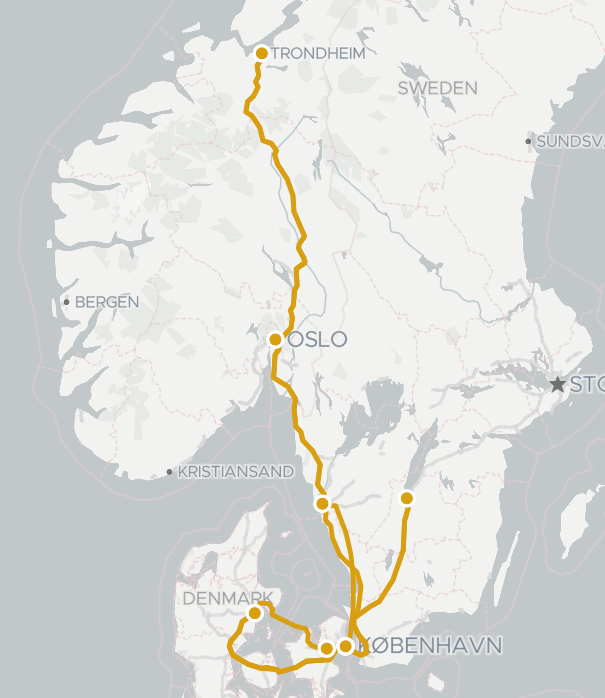
October in Scandinavia RIDE BOARD

From October 2-24 I'll be driving all over Scandinavia.  Anyone want a ride?

I'm doing another fine tour of Scandinavia for most of October, 2022.  I'm based out of Copenhagen for the tour, but I'm doing it all by rental car, and I have room for passengers.  If you can help pay for petrol, that's especially welcome.

The main drives I'll be doing that might be of interest:

October

5:  Copenhagen to Arhus
6:  Arhus to Copenhagen
8:  Copenhagen to Jonkoping
9:  Jonkoping to Copenhagen
14:  Copenhagen to Arhus
15:  Arhus to Roskilde
16:  Copenhagen to Trondheim (via Gothenburg and Oslo)
18:  Trondheim to Oslo
20:  Oslo to Smedjebacken
21:  Smedjebacken to Gothenburg
22:  Gothenburg to Copenhagen

If anyone wants to join me on any of those drives, just drop me a line.

Wednesday, September 7, 2022

Weekday Morning Music?

Seeking folks who play music, live in the area of Portland, Oregon, and have free time during school hours!
As of September, 2022, my kids are all in school, leaving me with a bit more time free.  I'm a dedicated musician, away on tour now and then, but I'm home most of the time.  I have no day job, so I particularly have time to play with during the morning and early afternoon on many weekdays when school is in session.  If you play music, live in the Portland area, and have some kind of compatible schedule, I think we should probably meet up for a wee jam one of these days.

You don't need to be a great musician to play great music, as you may already know.  If you have time free and the will to work out parts, amazing things can happen.  I'm mainly a singer/songwriter.  I play various instruments, but I don't sight-read or understand much theory.  I'm interested in meeting folks who play music and have free time during school hours, whether it might become a regular thing involving public performances of original music or just informal jam sessions.

In terms of my own music, you can look up David Rovics and check it out. Working out renditions of my own songs with different musicians is of interest, but I'm also inclined to branch out and figure out parts to other stuff. The main instruments I've been playing a lot lately aside from my voice are acoustic steel-string guitar, mandola, Irish bouzouki, and electric cello. I'm especially interested in meeting folks who play bowed instruments of any kind and have some kind of grounding in a folk music tradition from somewhere in the world. Of particular interest to me are Appalachian, Celtic, and West African folk idioms.

Please feel free to email me.

Thursday, September 1, 2022

The Search For A Fretted Cello

I love this cello, but now they make one with frets, and I would love to make music with one of those...

Goal:  $2,509
Raised so far:  $220


This is a video of me and the brilliant Lorna McKinnon from a gig in England in 2016.  I share it here specifically to highlight how cool the cello can be as an instrument to sing with.  It was around this time that I recorded an album called Punk Baroque, that heavily featured this very cello, which I had successfully managed to crowdfund for the year before.  It's a beautiful thing, made in the Czech Republic, and I play it a lot, still. 

I grew up playing classical cello, and only much later in life discovered the great possibilities the instrument has as one to accompany vocals, or to occupy that sonic space that instruments like the guitar, accordian, or banjo more typically occupy.  This was the idea I have been pursuing, on and off, with the NS Designs electric cello pictured above. 

I found a lot of advantages to the electric cello, over acoustic cellos.  Acoustic cellos are even more expensive, generally, and also very loud, by default, which makes them especially difficult to accompany vocals, unless you're singing opera (or otherwise very loudly).  The electric cello can be very quiet, and also of course can be amplified for big audiences, when you're amplifying everything, and it sounds great that way, much better than trying to mic an acoustic cello. 

But, as a guitarist and player of other fretted instruments, I was missing frets.  I have pretty good intonation on fretless instruments, but the fact is, if you're playing a lot of chords or two-note combinations, especially while also singing into a mic at some possibly awkward angle, and possibly playing in a situation where you can't hear everything perfectly, it's too easy for one or more of the notes to be slightly off-pitch. 

I was gifted with a gorgeous mandocello, which is a fretted instrument in the range of a cello, a wonderful thing which I treasure daily whenever I'm home, but as I've once again been getting into playing the cello, with a bow and all that, I once again started thinking about a cello with frets.  The thoughts in my head got loud enough that I bothered doing a web search, and to my delight I discovered that a cello with frets does exist, and just about the only outfit making them is the same company that made the beautiful (and fretless) electric cello I'm sitting next to right now. 

I'm probably a greedy man with too many instruments, but I figure it's still well within the realm of artistic license when for the most part I only have one of each type of instrument...  Here's the particular instrument I'm seeking to obtain, on the website of the maker of them.

If you are an instrument faery and you're in a position to just buy the thing for me, it's in stock here!

Friday, August 19, 2022

Pacific Island Sessions album project


Donate:  Pacific Island Sessions


There used to be a big thing called the corporate music industry.  The big three labels still exist, but they're much smaller than they once were, and they've mostly been supplanted by Big Tech. 

There also used to be a thing called the independent music industry.  There were independent record labels that made money for themselves and their artists by first investing in high-quality recordings, and then selling lots of albums.  When Spotify and the formerly much more major labels eventually made peace with each other, this led directly to the collapse of the independent music industry.  Overnight, after 2013, there was no more selling albums in any form for most of us, for the most part.

With the sudden loss of about half of the income of most independent touring artists, all kinds of crowdfunding platforms became popular, as an alternative means to support the ongoing existence of touring artists who can afford to make the occasional record.  Like many other artists today, I mainly survive from crowdfunded patronage, through a Community-Supported Arts program I set up on my website, and through Patreon.

However, I have personally found that although crowdfunded patronage has been absolutely tremendous in allowing me to continue to pay the rent and feed my family, it has never reached the level of support that would be needed for me to be able to come up with the thousands of extra dollars that are generally needed in order to get a bunch of musicians together to put time into an album project. 

Through the height of the Covid-19 lockdown era, you can thank the Pandemic Unemployment Assistance program for helping to fund several records I put out in 2020 and 2021.  But that's over, and we're back to begging from the Crowd. 

Here's a playlist of some of the songs that are likely to be recorded in January.
 

Here's a little video introducing folks to Chet's home studio.


Sunday, July 17, 2022

Some Thoughts on Antifawatch.net

A few days ago I got a message from someone who wanted to let me know about some bad news:  that I had a listing on an apparently infamous rightwing website called Antifawatch.net.  This is bad news presumably because being featured on this website means you're on some kind of hit list.

Not to dismiss the inherent threat of violence we're talking about here -- it's real enough.  But there's another rightwing, violent-prone network of Zionists, the followers of the assassinated rightwing rabbi Kahane, who put me on their SHIT (Self-Hating International Terrorists) list decades ago, and I'm still here.  More than that, I have the same level of security as most members of the Congress have -- so many of whom receive death threats and similar messages every day -- which is none.  Which is just to say that fortunately, most threats on the internet do not get carried out.  Little comfort, perhaps, but more than none.

Since learning of the existence of this sad little website, though, I'll make a few observations about its content.  

The website features 1,130 listings altogether -- not many, considering it's supposed to be a crowdsourced database of antifascists.  There are a lot more than 1,130 people in the US who would fit their definition of antifascists, even if it were much stricter than it is.  Of the 1,130 listings, a very large number are from Portland, Oregon.  

This rightwing community's definition of "Portland Antifa" is extremely broad, and includes lots of community organizers, union organizers, tenant organizers, progressive candidates for local political office, pacifists or other people who have had zero involvement with anything remotely resembling street fighting -- as well as some of the young folks earnestly trying to drive the Proud Boys out of town or burn down their local police station, who might fit the more typical understanding of the term "Antifa."

My favorite part of their listing about me is the graphic.  Many other listings only get a mug shot for a graphic, but I get a nice collage.


There are certain things they clearly think are important to highlight from this graphic.  One is that I am pictured in the upper right performing in front of a Palestinian flag.  This photo was taken in Palestine, in fact.  How it is relevant, I assume, is that it is bad to play in front of a Palestinian flag or to be supportive of the Palestinian struggle, and good to support the self-proclaimed Jewish State.  Rightwingers these days support Israel, just like my pretend anarchist critics do.

The next graphic, taken from the cover of a 2021 album, May Day, refers to May Day as "the commie New Year."  Apparently these rightwingers are not aware, or not interested, in National Socialism of the sort that is interested in the prosperity of the working class.  The Nazis marched on May Day in large numbers, and would not have appreciated May Day being called a "commie" anything, despite its origins within the American labor movement.

Demonstrating that rightwingers can have a sense of humor, too, they refer to the hoodies available for purchase on my website as my "spring riot-wear collection."

Here's the text of the current entry on me that they have below this graphic:

David Stefan Rovics (DOB: 04/10/67) is a folk singer/song writer and a self-professed Antifascist. The left is often alleged to be fratricidal and his interactions with Portland Antifa appear to support the theory. He recently (2022) entered into a social media cancellation war with several Portland area online Antifa personalities such as Shane Burley. The Antifa trolls accused their fellow leftist, apparently unironically, of antisemitism and holocaust denial. They even claimed he associates with neo-Nazis which is unlikely because Rovics seems to be a hard-left antifascist. The Portland trolls contacted one of the NYC Antifa groups that was hosting a concert Rovics was performing at and attempted to have his performance cancelled. Rovics retaliated by doxxing the trolls accounts (but not the Antifa behind the accounts) on his blog. He also posted an antifascist survey on his blog. 

Rovics is another antifascist alum of Evergreen State College. He seems to advocate for tenants issues which isn't surprising given he lives with his wife and kids in a rather modest apartment in southeast Portland.

For the record, for whatever it's worth, there are a couple points here I'd like to correct.

I'm not a "self-professed Antifascist."  I'm against fascism.  No professing involved.

They accurately describe Shane Burley as a troll, though the term "self-professed antifascist" could be used to describe this cancellation campaigning apologist for Israeli apartheid instead.  Although it may be accurate to describe much of the modern American left as fratricidal, I'd extend their tribal warfare reference here to invite them to consider that while the left is fratricidal, more fratricidal still is the working class, of which most of the contributors to Antifawatch.net and most of the people they describe as Antifa undoubtedly are a part.  We are being used -- you, too, Antifawatch.net.

The apparently not very intelligent individuals contributing to this website who obviously don't do research for shit can't even figure out why my allegedly antifascist trolls are constantly attacking me, so I'll help them:  I talked to one of you guys.  Or at least that's what my critics say.  I talked to a fascist.  Or an ex-fascist, depending on who you ask, like if you ask him (him being Matthew Heimbach).  So if by "hard left" they mean I don't talk to people I have disagreements with, I'm not that guy.  And neither are so many of the people they have categorized ridiculously as "Portland Antifa." 

On their own website they seem to be careful about not sharing home addresses of people they have listings for.  I assume this is something they do for legal reasons, so they're not accused of "doxxing."  Oddly, though, they say I "doxxed" my allegedly antifascist trolls (after said trolls engaged in organized campaigns to get my gigs canceled).  However, I did not reveal the name or home address of anyone.  So this must be a new definition of "doxxing," along with their new definition of "Antifa."

These people are a joke (of the "own goal" variety), though probably a very well-armed one.  

I just hope they -- along with my "antifascist" trolls who say the same kind of stuff about me -- will someday soon wake up from their brainwashed, tribalistic stupor, turn off their computers, and see the world around them.